


Surgery
What is Trigger Finger?
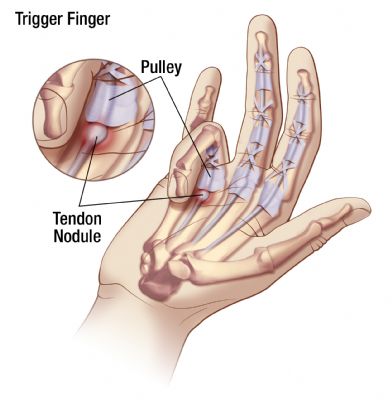
Trigger finger, also known as stenosing tenosynovitis, is a painful condition that affects the tendons in the hand. When the finger or thumb is bent towards the palm, the tendon gets stuck and the finger clicks or locks.
Trigger finger can affect one or more fingers. The symptoms can include pain, stiffness, clicking and a small lump of tissue at the base of the affected finger or thumb (known as a nodule).
Information for patients
Your doctor has referred you to us because you may have symptoms of trigger finger or thumb.
What is it?
It is a condition which happens as a result of a localised restriction to straightening a finger. This is caused by a thickening of the tendon and there is a mismatch between the size of the tendon and its sheath making it difficult for the tendon to pass through a pulley in the palm of the hand.
What symptoms does it cause?
Usually bending the finger is normal but beyond a certain range of movement, the sufferer has difficulty straightening the bent finger. This often straightens suddenly and a ‘click’ may be felt. There may be some pain and sometimes a little lump can be felt at the point of obstruction. The digits most commonly affected are the ring and middle fingers and sometimes the thumb.
What are the causes?
The cause is usually unknown in adults. Sometimes it may be associated with certain medical conditions like diabetes, rheumatoid arthritis or gout.
Treatment
This may consist of simply keeping the finger straight with a splint and the use of oral anti-inflammatory drugs.
The recurrence rate is high.
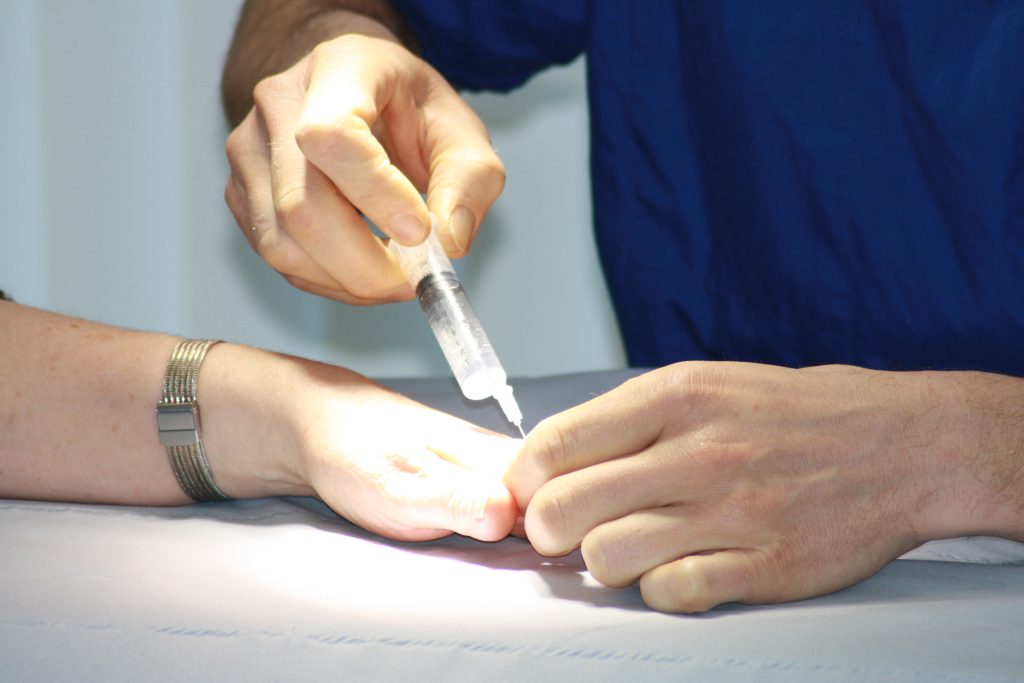
A steroid injected into the tendon sheath is usually successful for early disease with minimal functional impairment.
Following the injection please exercise your thumb or finger immediately.
If triggering is severe and/or injection has failed, surgical release gives the best long term relief.
You will be seen and assessed and if you are offered an operation, the following information may be useful.
The operation
The operation is done under local anaesthetic and a tourniquet in the upper arm. This numbs the site and wears off after a few hours. The fingers may also go temporarily numb. A 2cm cut is made at the base of the affected finger in the palm. The thickened sheath is divided.
You should then be able to move your finger freely and we are able to check this under direct vision. The wound is then closed with some absorbable stitches. The hand is then bandaged and rested in a sling to minimise swelling. The procedure takes about 15 minutes.
Please ensure that you remove all rings from your fingers before your appointment and that you wear a loose sleeved top. Also ensure that you have someone to drive you home afterwards.
If you are on warfarin, clopidogrel or dipyridamole (persantin) please contact our surgical team for further information as soon as possible.
Post-op care
Use the sling for the first few days until you are feeling comfortable and you are sure there is little or no swelling in the fingers. Take the arm out occasionally to exercise the elbow and shoulder. At night keep the sling on and sleep in a semi-upright position or place the hand on some pillows to elevate it.
Start finger exercises immediately and repeat frequently. Fully straighten and bend the fingers for a few minutes every hour. This helps to prevent stiffness.
STITCHES – Keep the dressing dry and intact till your stitches are removed. These will need removed 10-14 days after your procedure by your GP Practice. Staff on the day of your procedure will have advised what date these need removed.
DISSOLVABLE STITCHES – These will not need removed. Keep the mepore dressing dry and on for a week.
You will be advised in clinic what type of stitches have been used and given post operative advice to take home.
Pain control
You will be offered some pain killers to take home.
We recommend taking them as soon as you get home and then regularly for the first 48 hours.
Recovery
Some soreness, bruising and swelling is normal. The scar may be sensitive for 2-3 weeks. Most people are able to return to normal activities by that time. Patients can self certificate for the first week and then get a sick note following this from their GP if necessary.
Complications and risks
Any surgical procedure has an element of risk attached to it and occasionally things do not turn out as well as expected. Fortunately with trigger finger release the risks are small and the outcomes usually very good. There is a small risk of recurrence.
Serious infection is extremely rare, but you must take care to keep the dressings clean and dry. If you experience a lot of pain in the hand, swelling of the fingers, high fever or flu-like symptoms you should immediately seek advice. Minor, superficial infections may require antibiotics.
Damage to the small nerves and blood vessels on either side of the finger during the operation, causing numbness in the finger is uncommon as great care is taken to avoid them.
Scar tenderness can persist for several weeks but usually settles down in time.
Some patients who are not progressing satisfactorily because of persistent post-op pain, stiffness or finger swelling may require physiotherapy but this is unusual.
A rare complication of injury to the hand, including surgery is “chronic regional pain syndrome”. The hand is disproportionately painful and stiff with some swelling. You should seek advice promptly if you experience such symptoms. This can last for many months and is difficult to treat.
Where to get advice
If you have any concerns during the post-op period you can get advice or help from one these sources.
- Try your own doctor or nurse
- Contact one our of the surgical team
- Out of Hours Service – contact the emergency number provided by your surgery
- Your local Emergency Department
Severe pain, excessive swelling or bandages that are too tight or bloody should prompt you to seek advice. Take this letter with you and insist that the dressings are removed and the wound inspected before redressing.
Students
We are a teaching and training practice. Sometimes medical students or doctors in training may wish to observe or participate in procedures or operations. They will always be supervised by a senior doctor and will only participate with your approval.
If you do not wish to be seen by trainees or students you are perfectly entitled to withhold your consent.